Tokenization has two halves. One of them is close to a solved engineering problem, and the industry has spent five years perfecting it. The other one is barely started, and it is the half that decides whether any of this reaches regulated markets at scale. The solved half is the asset: define an instrument, mint a transferable unit, record it on a shared ledger, settle both legs atomically, run it around the clock in fractions. The unsolved half is the counterparty: who holds this, are they permitted to, is this transfer allowed, can a supervisor see it without asking, and will the signature that proved the issuance still be sound when the asset matures.
This piece is the long technical account of how KXCO builds the second half, and why building it first changes what the first half is worth. It covers the closed environment and why admission runs through exactly one door, the credential model and how a party becomes known, the ontology that lets an instrument carry its own meaning and its own restrictions, the transfer check that runs before clearing rather than after settlement, the post-quantum signing that has to outlive thirty year assets, and the position of AI agents as scoped, attributable parties rather than invisible extensions of their principals.
A tokenized asset is only as good as the environment's ability to say who holds it, what it means, whether this transfer is allowed, and whether the proof will still verify decades from now; KXCO builds that environment as a closed system of known and approved parties over an ontology that types every instrument and a post-quantum record anyone can check without being admitted.
How to read this. Sections 01 to 03 are the argument, and they are the ones to send to a sceptic. Sections 04 to 09 are the architecture, including three interactive graphs you can drag and inspect. Section 10 is the part most roadmaps have not priced, and section 11 is the part arriving faster than section 10. Section 14 is what I claim and what I do not, stated plainly, and section 15 is how to build against it today. The shorter market-facing version of this argument, with the same graphics, is published on Live Trading News as Real World Asset Tokenization: The Missing Half.
01The bottleneck, named out loud
It is unusual for the largest asset manager in the world to publish the specification for a piece of missing infrastructure, but that is roughly what happened. In BlackRock's 2025 annual chairman's letter, Larry Fink wrote that every stock, every bond and every fund, indeed every asset, can be tokenized, and that if they are it will revolutionise investing. That sentence travelled everywhere. The one immediately after it did not:
If we're serious about building an efficient and accessible financial system, championing tokenization alone won't suffice. We must solve digital verification, too.
He returned to the point in the 2026 letter. There he compared tokenization to the internet in 1996, observed that half the world's population already carries a digital wallet on a phone, and argued that tokenization could accelerate broader participation in markets by, in his words, "updating the plumbing of the financial system". He also called for clear rules on investor protection and on digital identity as preconditions for trust in tokenized markets, and disclosed close to $150bn of BlackRock assets connected to digital markets. This is not a man theorising from outside the trade.
Read across the two letters and the claim is narrower and more useful than the headlines suggest. It is not that tokenization needs better tokens. It is that tokenization is gated on the ability to establish, cryptographically and at machine speed, who is on the other side of a transaction and what they are permitted to do. Everything else is downstream of that.
The same conclusion shows up from three other directions, from institutions with no commercial interest in agreeing with each other.
The Bank for International Settlements has been building toward a tokenised unified ledger, an architecture in which tokenised central bank reserves, commercial bank deposits and other assets coexist on interoperable platforms under common technical and regulatory standards. When the BIS published its position in June 2026, its General Manager, Pablo Hernández de Cos, framed the objective as integrating digital innovation such as tokenisation into the existing financial architecture so that authorities can shape the future of money and the financial system in the public interest "while preserving trust". Project Agorá, the associated public-private effort, involves eight central banks and more than forty regulated institutions. Note what that construction implies. The participants are regulated and identified. Nobody proposed a unified ledger open to anonymous holders.
In the United States, the Securities and Exchange Commission under Chairman Paul Atkins has moved toward what he has described as an "innovation exemption", a framework to allow the trading of tokenized securities on chain in a compliant fashion, which he characterised as "an important step toward facilitating the integration of tokenized securities into our existing financial system". The operative word in both phrases is compliant. An exemption that lets tokenized securities trade does not suspend the identity, eligibility and reporting obligations attached to securities. It presupposes that a platform can discharge them.
And from the International Monetary Fund, a warning about the party nobody has onboarded yet. Its 2026 note on agentic AI in payments points out that existing fraud and compliance frameworks were built to verify customers, not agents, and that AI systems capable of executing payments expose gaps in KYC and multifactor authentication that assume explicit human action. The response now forming in the industry carries the label "know your agent", alongside continuous rather than one-off identity verification.
Four institutions, four vocabularies, one requirement: provable identity and provable authority, at the speed the settlement layer runs. That requirement is the subject of this piece.
02What the market built, and what it left out
Start with what works, because it genuinely does. The engineering of the asset half is finished to a standard that would have looked fantastical in 2020.
The scoreboard as at August 2026 is roughly $37.7bn of tokenized real world assets in distribution. About $16.1bn of that is tokenized US Treasuries, which is over forty per cent of the total and tells you where institutional comfort actually sits. Tokenized private credit is about $7.1bn. Commodities, overwhelmingly gold, are about $4.8bn. Tokenized public equities and tokenized private equity and venture interests are each around $2.3bn. Real estate, the asset class that gets the most tokenization conference slides, is about $203m, which is a rounding error and the most instructive number on the list.
Forward estimates are large and should be treated as directional rather than precise. Citi has projected tokenized securities reaching approximately $5.5 trillion by 2030. Boston Consulting Group and ADDX have projected around $16.1 trillion for tokenized illiquid assets on a broader definition. JPMorgan's blockchain unit reports more than $3 trillion of cumulative transaction volume and several billion dollars of daily flow, on a network where only vetted counterparties transact and its deposit token is available to approved institutional clients, not to retail and not for permissionless trading.
Tokenized Treasuries are at roughly $16.1bn. Tokenized real estate is at roughly $203m, a ratio of about eighty to one. The difference is not technological, because a property interest is no harder to represent as a token than a Treasury bill. The difference is that a Treasury has essentially one uniform holder eligibility question and a property interest has dozens, spread across title, tenancy, jurisdiction, tax status and transfer consent. The market has tokenized precisely the assets whose counterparty problem is trivial, and stalled on the assets whose counterparty problem is real.
That ratio is the whole argument in one statistic. The assets that scaled are the ones where you barely need to know anything about the holder. The assets that did not scale are the ones where holder identity, eligibility and permission are the substance of the instrument rather than an administrative wrapper around it.
What got left out, concretely, is a list of five questions that a token and a ledger cannot answer between them:
- Who is the holder, in law rather than in hexadecimal. An address is a public key. It has no name, no domicile, no legal form, and no relationship to any register that a court would recognise.
- Are they permitted to hold this instrument, here, today. Eligibility is a function of the holder's classification, the instrument's terms and the jurisdiction, and all three change over time.
- Is this specific transfer allowed, before it clears. Lockups, rights of first refusal, transfer consents, concentration limits, holder count caps and jurisdictional prohibitions are conditions on the transfer itself, not annotations to be reconciled afterwards.
- Can a supervisor read the position without asking anyone. If the answer requires an email to an operator, the record is not a record. It is a claim about a record.
- Will the proof still verify at maturity. A signature is a time-bounded assumption. Long dated assets outlive assumptions.
Every one of those questions is about the counterparty, not the asset. None of them are answered by a better token standard, a faster chain or a lower gas fee. They are answered by an environment.
03A claim needs a holder
Strip the vocabulary away and a tokenized real world asset is a claim. Somebody owes somebody something, on stated terms, enforceable in a stated place. The token is a representation of that claim, and a representation is only as good as the thing it points at and the record of who holds it.
This is where a great deal of tokenization work quietly goes wrong. Mint a token representing a bond and deliver it to an address, and the intuition is that a tokenized bond now exists. It does not. What exists is a transferable marker whose holder cannot be identified, whose eligibility cannot be tested, whose transfer cannot be restricted, whose position cannot be reported and whose entitlements cannot be paid without an off-chain register deciding who to pay. The real bond is still recorded in a transfer agent's system. The blockchain has become a very fast, very expensive shadow of a register that continues to be the register.
The failure is not that the technology does not work. It is a category error about what was being represented. Ownership of a regulated instrument is not a bearer relationship between an asset and a keyholder. It is a relationship between an asset and an identified, eligible party, together with the history of how that relationship came about and on whose authority. Represent the first half and omit the second, and you have built a bearer instrument with a receipt, which is the specific thing that a century of securities law exists to prevent.
Tokenize an asset without tokenizing the counterparty and you have not moved the register onto the chain. You have added a second register that disagrees with the first one.
Look at what falls out of the model the moment the holder is unidentified. Entitlement payments have to be made from an off-chain list, so the chain is not the source of truth for cash flows. Corporate actions cannot be executed on chain, because you cannot poll or notify holders you cannot name. Tax withholding cannot be applied, because withholding is a function of holder residence. Position reporting has to be reconstructed from analytics vendors making probabilistic guesses about address clustering. Restrictions can only be enforced retrospectively, by freezing tokens after a prohibited transfer has already occurred, which converts a control into an incident. And in a default, the enforcement question, who exactly do I sue, has no answer the ledger can supply.
Turn it around and the design follows immediately. If the holder is identified, eligible and credentialed before any position exists, then entitlements can be computed on chain, corporate actions can be executed against known holders, restrictions can be evaluated as preconditions rather than remedies, reporting is a read rather than an inference, and enforcement has a named party. Every one of the hard problems dissolves, and it dissolves because of a decision made at admission rather than a feature added at the token layer.
Which produces the design rule that everything else in this piece follows from. Nothing is issued before somebody is known. Not as a policy that operators are trusted to follow, but as a property of the system: there is no code path from an unverified party to a held position.
04The closed environment
A closed environment is a system in which every participant has been admitted through a verification process, holds a credential recording that admission, and can be attributed for every action they take. It is the opposite of a permissionless network, and it is not the same thing as a private one.
The distinction that gets lost, and the one worth insisting on, is between admission and verification. Admission is closed. Verification is open. You cannot participate without being admitted, and you do not need to be admitted to check anything. Most discussions of permissioned infrastructure collapse those two into one, which is how "permissioned" acquired its reputation for meaning "you have to take the operator's word for it". In this design you never have to take anyone's word for anything.
Concretely, the perimeter has four properties.
One door. There is a single admission path, and it is the KYC or KYB verification described in the next section. Adding a second path, for convenience, for a pilot, for a favoured counterparty, destroys the guarantee entirely, because the guarantee is not "most parties are verified", it is "an unverified party cannot hold anything". This is why the door is an architectural feature rather than an onboarding workflow. Workflows get bypassed under deadline pressure. A missing code path cannot be.
Attribution by default. Every consequential action is performed by a credentialed party and recorded against that credential. There is no anonymous write. This is what makes the audit trail an audit trail rather than a log, and it is also what makes the AI agent question tractable later: an agent is simply another credentialed party, and the machinery that attributes a human's action attributes a machine's.
Refusals are recorded. When a check fires and blocks something, the block is written down with its reason. This sounds like a detail and it is one of the load-bearing decisions in the whole design. A control that leaves no trace when it fires is indistinguishable, six months later, from a control that was never invoked. Supervisors do not want to be told that the controls work. They want to see them working, including on the occasions when they said no.
Open verification. Anyone can verify a proof with a published public key and the record. No account, no allowlist, no API key, no relationship with KXCO or with the operating institution. On Meridian this is live as an unauthenticated verification endpoint, deliberately kept content-free: it returns the signed payload digest, the signature, the anchor and how to check them, never the underlying document. That combination, verifiable but not readable, is the property that lets a closed environment satisfy an outside party without leaking anything.
It is worth being explicit about who operates all of this, because it constrains the architecture more than any technical choice. KXCO is a software company. It holds no client assets, runs no exchange, is not a custodian and carries no financial licences. The licensed institution operates the environment and carries the obligations. That division is not modesty, it is the reason the controls have to be enforced in software rather than in procedure: a vendor that cannot be the operator cannot promise that the operator will behave, so it has to ship a system in which the misbehaviour is not expressible.
05Admission: how a party becomes known
Admission is the only place in the system where an outside fact becomes an inside fact, so it deserves the most scrutiny. The sequence has four steps and each one exists for a reason that is not obvious until you consider what happens without it.
Step one: verification, performed by somebody licensed to perform it
A person is verified through KYC and an entity through KYB, including beneficial ownership and control, with sanctions and politically exposed person screening at the same gate. This is executed by a regulated verification provider, not by KXCO. That is a deliberate boundary. KXCO holds no financial licences, and a software company that performs its own identity verification while claiming not to be regulated is making a claim it cannot support. The provider's result is the input; the platform's job is to bind it to a credential in a way that cannot be forged or backdated.
What the platform records is the verification's result and reference, not its raw contents. The credential can carry the provider's applicant identifier, the country, the verification level and the date, without the platform holding a copy of a passport image. That distinction matters for data protection, and it matters for breach blast radius: the useful artefact is the attestation, and the attestation is not sensitive in the way the underlying documents are.
Step two: issuance under an institution key
Once verification returns, the operating institution issues a credential signed under its own key using ML-DSA, the NIST FIPS 204 lattice signature standard at Category 3 parameters. The credential names a subject, a role, an authority and the verification reference. This is a hierarchy rather than a flat list: the institution's key is the root of trust, each holder credential chains to it, and a verifier walks the chain rather than consulting a database. That property is why verification works from outside the perimeter with nothing but a public key.
Institution key material sits behind a hardware boundary, and the key that issues identity credentials is kept separate from the key that seals document envelopes, so compromising one does not let an attacker mint the other.
Step three: the identifier the user actually sees
Users see one identifier: the KXCO ID. They do not see key fingerprints, algorithm names or internal handles, and that is a product decision with a security consequence. An identifier a human can read out loud, quote in an email and check against a public page is an identifier that gets checked. A hex fingerprint is an identifier that gets pasted without being read.
Each new identity is also given a marker wallet on Armature L1, so every credentialed party has an on-chain presence from the day it is admitted.
Step four: rotation and revocation, designed in rather than added
A credential system without a rotation story is a credential system with an expiry date it has not admitted to. The design commitment here is twofold: rotating a key never invalidates a historical record, and the rotation itself is an artefact a verifier can check rather than an announcement it has to trust.
What the audit trail is made of
Admission and everything after it is written to a tamper-evident log: each entry signed with ML-DSA (FIPS 204) and hash-chained to its predecessor, with a verification routine that replays every signature and every previous-hash link rather than checking the head. The distinction is worth stating because a great many "immutable audit logs" verify only that the last entry is well formed, which detects nothing if an entry in the middle was rewritten and the chain recomputed. Replaying the whole chain against signatures the log's operator cannot forge is what makes tampering detectable by somebody who is not the operator.
06The complete ontology
The credential answers who. The ontology answers what. It is the harder half to demonstrate and the more durable advantage, because credentials are copyable as a design and a shared model of meaning is not.
A value is a typed claim, not a number
The core commitment is that no value in the system is a bare number. Every value is a claim carrying five things: what it means, the source it came from, the date on which it was true, a confidence, and the basis on which it is asserted. A figure of 1,131,530,053 is not data. A claim that the completed-asset value of a specific development was 1,131,530,053 Thai baht, as stated by the sponsor, as at a stated date, at stated confidence, on the basis of a sponsor information sheet, is data. The first can only be trusted by asking somebody. The second carries everything needed to decide how much weight it deserves.
The corollary is that the model can say "unknown" as a first-class state rather than as a null. This sounds pedantic and it is one of the most useful properties in practice. A null is ambiguous between "zero", "not applicable", "not yet loaded" and "we could not find out", and code downstream will guess. Typed opacity states force the distinction to be made explicitly, which means an agent reading the model can tell the difference between a value that is zero and a value nobody has established.
The ontology does not discover anything and it does not hand down conclusions. It renders structure legible so that a person, a supervisor or an agent can see something that prose hides. The discovery is always the human's; the system's contribution is making it reachable. More compute does not substitute, because a larger model returns a fluent paragraph, and a fluent paragraph is not a shape you can see a concentration in.
Applied to a tokenized instrument
Type a real world asset into the model and the token stops being a ticker with a balance. It becomes an object that knows what kind of instrument it is, which classes of holder may hold it, in which jurisdictions, under what restriction periods, with what consent requirements, and on whose stated authority each of those terms rests. The ledger records the ownership. The ontology records the meaning. Both are needed and they are not the same artefact.
The reason this matters more in tokenization than almost anywhere else is that tokenization multiplies the number of counterparties who must agree on the meaning of a term. In a bilateral private placement, two sets of lawyers reconcile definitions once and the reconciliation lives in a document. In a tokenized instrument that can move between many holders, potentially across jurisdictions, potentially at machine speed, there is no opportunity for a bilateral reconciliation, and every participant holding a private interpretation is a settlement failure waiting for the right pair of trades. One shared model is not a nicety. It is the only configuration in which the instrument can move at all without a human adjudicating each hop.
The public instance, and what it demonstrates
The method is not theoretical, and it is running in public. KXCO maintains a live ontology of the artificial intelligence and compute sector at kxco.ai/ontology-live, which as at its August 2026 snapshot carried several hundred entities and over eight hundred typed claims, each edge a sourced assertion with a date and a basis, plus a set of ranked findings and explicit opacity states where a figure could not be established. Coverage is reported rather than implied, and cells that are unsourced are marked as unsourced rather than filled in.
That instance exists as a demonstration of a discipline, not as a tokenization product. Its value here is that it shows the same claim structure operating at scale on messy public data, with an integrity harness that fails a build on validation errors and a test that fails if any renderer displays a raw value without its provenance. A model that permits an unsourced number to render as a fact will eventually contain one.
07The lifecycle, stage by stage
Here is the whole path, from a party who does not yet exist in the system to a position a supervisor can verify. The stages are ordered by dependency rather than convenience, which is the point: several of them cannot be reordered without breaking a guarantee.
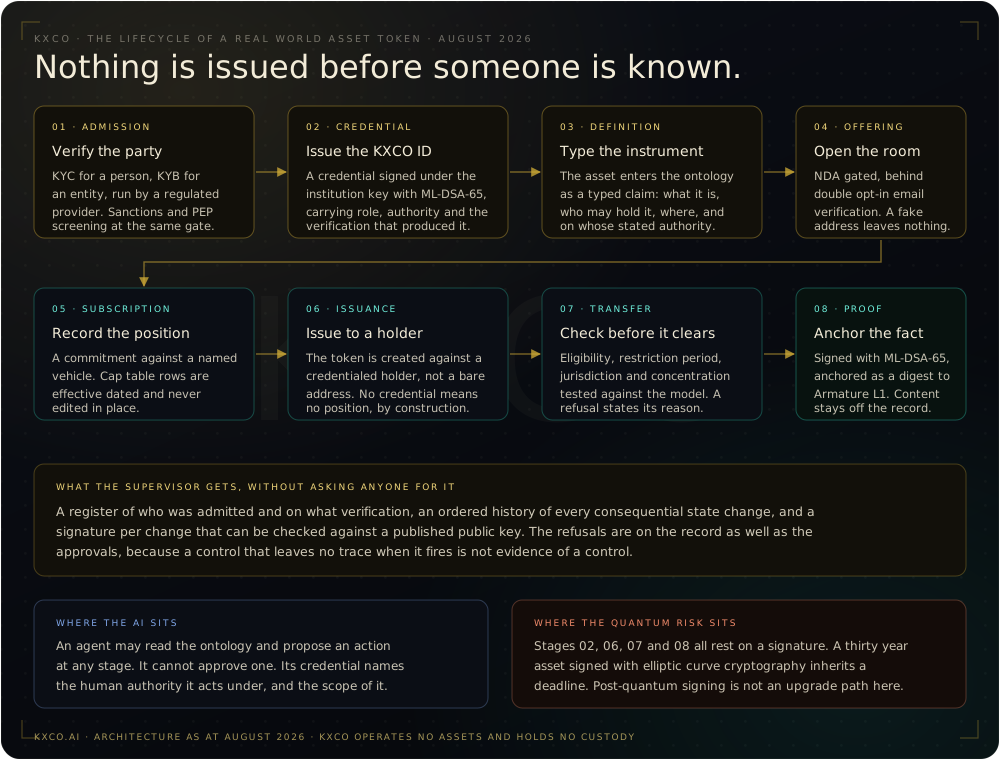
01 and 02: admission and credential
Covered in section 05. The only thing to add in lifecycle terms is that the credential is issued before any offering is visible to the party, not after they have expressed interest. Verification-after-interest is the common shortcut and it inverts the risk: it means unverified parties have already seen the deal.
03: typing the instrument
The asset enters the ontology with its terms as typed claims, each carrying the document or authority it derives from. This is also where the platform earns its keep as a discipline rather than a database, because typing an instrument forces the terms to be stated precisely enough for a machine, and that process reliably surfaces contradictions that prose had been hiding. On a live real estate loan room, typing the sponsor's own figures surfaced a stated construction area implying a plot ratio of over thirteen to one, which is almost certainly a square feet against square metres error, a unit count that did not sum to the stated total, and a percentage-sold figure that reconciled to neither the unit count nor the value. None of that was discovered by an algorithm. It became visible because the model would not accept the numbers without stating what each one meant.
04: the offering and the room
An offering is published into a data room gated by an NDA and by double opt-in email verification, so a fabricated address gains nothing and leaves nothing. Rooms are first-class objects with their own owner and their own named co-administrators, and authorisation is computed from room ownership rather than from who issued the deal, which means issuing a deal that borrows somebody else's room confers no rights over that room. That rule is enforced by the system itself, not by a policy document.
05: subscription and the register
A commitment is recorded against a named vehicle, and the register is effective dated, so it can be read as at any past date and a change never overwrites the history it replaces. The register cannot be oversubscribed, and a refusal states how much room is actually free rather than failing generically.
Splitting an amount across holders reconciles exactly or refuses. The allocation never invents a penny, never loses one, and never lets an arbitrary ordering decide who receives the difference.
06: issuance to a credentialed holder
The position is created against a credential, not against a bare address. This is the stage where the guarantee from section 04 either holds or does not, and it holds because there is no alternative constructor.
07: the transfer check
Covered in section 08.
08: proof
Consequential state changes are signed with ML-DSA (FIPS 204) and anchored to Armature L1 as a digest. The content stays off the record: what is anchored is a commitment to the relevant state, plus identifiers and a timestamp, never the substance of the deal. On Meridian this is implemented as selective attestation, opt-in per organisation and per event type with a fixed enumerated list of attestable events so the scope cannot drift.
Two guarantees in that path are worth stating. A chain outage can never fail a business action, because anchoring is decoupled from the action it proves and catches up when the chain returns. And anchoring is idempotent, so a replay can never produce a second proof of the same fact.
Capital movement follows the same philosophy. Capital calls are split by the capital table as at the call date rather than as at today. Payments are recorded with their own value date, so a part payment in March and the balance in June are two dated contributions accruing over their real periods, rather than one contribution dated whenever somebody typed it in. Preferred return accrues on capital still outstanding rather than on capital originally contributed. And bank statement lines match to obligations only on positive identification of the payer, so an investor is never credited with money they did not send.
08The check before clearing
The single most important behavioural difference between this design and the prevailing one is when the check happens.
In the prevailing design, restrictions are contractual. A subscription agreement says a holder may not transfer for twelve months, or may not transfer to a person outside a permitted jurisdiction, or may not transfer without consent. The token knows none of this. A prohibited transfer therefore succeeds on chain and becomes a legal problem afterwards, remedied by freezing, by forced unwinding, or by litigation. The control exists, but it operates as a remedy rather than as a control.
In a closed environment, the same restriction is a precondition. A proposed transfer is evaluated against the instrument's own terms and the parties' standing before anything clears. The transfer either proceeds or is refused, and a refusal states its reason and is recorded.
The same before-the-fact pattern already governs authority inside the platform, and it is instructive because it shows what the pattern looks like once it is real rather than aspirational. Roles on a vehicle are separated from ownership of it: who may act is an explicit grant, and who owns is the capital table. The governing rule is that the administrator prepares and the manager approves. An administrator may raise a capital call, prepare a distribution and reconcile the bank, and may not change ownership, edit vehicle terms, post a distribution or widen its own access.
Two refusals in that engine illustrate the standard. Modelling a distribution is permitted for a preparer, and changing the terms that distribution runs against is not, so a fund administrator can show the manager what a payout would look like without being able to alter what it would be. And a carry allocation with no general partner role granted is refused rather than quietly redistributed to investors, because silently paying somebody else's money to the right-looking party is worse than stopping.
One asymmetry in that design is worth explaining because it looks inconsistent until you see the reasoning. An administrator may issue a capital call but may not post a distribution. A call asks for money and can be withdrawn or reissued; a distribution releases money and cannot be unsent. Where an action is irreversible, the approval sits with the accountable party. Where it is reversible, it does not need to.
It is worth being precise about the boundary of what is enforced where. The permission model above governs the platform's own state transitions today and is in production. Enforcing the same checks at ledger level is the design and is the right end state for a transferable instrument; it is not something to claim as finished. Section 14 says exactly where the line currently sits.
09Regulation as architecture
There is an assumption in digital assets that regulation is friction to be minimised. For real world assets that assumption is wrong, and it is the reason so many projects stall at pilot. The asset is regulated whether or not the token acknowledges it. A tokenized mortgage participation does not stop being a mortgage participation because it moved onto a ledger, and a supervisor's interest in it does not diminish because the register is now a Merkle tree.
So the productive question is not how little supervision the design can tolerate. It is what a supervisor actually needs, and whether the architecture can produce it without anybody being asked. Three artefacts answer that.
A register of admission. Who was admitted, on what verification, by whom, on what date, and under what credential. Because admission is the only door, this register is complete by construction rather than by diligent record keeping.
An ordered history. Every consequential state change, in sequence, each one signed and each one anchored. Including the refusals. A supervisor reviewing a control environment is looking for evidence that controls fire, and the only convincing evidence is a population of occasions on which they did.
Independent verifiability. A signature per change that checks against a published key, so the supervisor's confidence does not rest on the operator's cooperation. This is the artefact that distinguishes an auditable system from a system with good reporting.
The two unglamorous artefacts that decide procurement
Beyond the technical properties, two documents determine whether a platform is treated as market infrastructure or as novel software, and both are the sort of thing engineers systematically underweight.
The first is a self-disclosure against the CPMI-IOSCO Principles for Financial Market Infrastructures. A large majority of central counterparties and most central securities depositories publish one. Risk and compliance teams at licensed institutions ask for it before signing, and the reason is not bureaucratic: with a PFMI self-disclosure, a platform can be mapped onto a risk framework the institution already operates. Without one, every conversation restarts from first principles, and first-principles conversations do not survive procurement committees.
The second is ISO 20022 message mapping. It is the dominant institutional payment messaging dialect, and if a platform's APIs do not map cleanly onto the relevant message types, every integration needs a translation shim. That shim will be identified by the bank's integration team in the first week of discovery, and it will be priced. Weighting this above net-new feature work is counterintuitive and correct.
The point of naming both is that they are load-bearing in exactly the situations where throughput numbers are not. No institution has ever declined an integration because a settlement layer ran at two-second finality rather than one. Plenty have declined because there was no document their risk team could map.
10The signature outlives the asset
This is the section most tokenization roadmaps have not priced, and it is the one part of the stack that genuinely cannot be retrofitted.
Reduce a tokenized asset to its essentials and it is a signature plus a record. The token contract is code, the interface is convenience, the custody arrangement is an operational choice, but the thing that makes the arrangement provable is a signature over a statement about ownership at a moment in time. So the security of the whole arrangement, over the whole life of the asset, is the security of that signature.
Now put dates against it.
NIST published the post-quantum standards, FIPS 203 for key encapsulation, FIPS 204 for lattice-based signatures and FIPS 205 for hash-based signatures, in August 2024. In May 2025, BlackRock amended the prospectus of its iShares Bitcoin Trust to add a quantum computing risk factor, in language stating that developments in mathematics and technology, including advances in digital computing, algebraic geometry and quantum computing, could result in the relevant cryptography becoming ineffective. In June 2026 the White House signed Executive Order 14412, "Securing the Nation Against Advanced Cryptographic Attacks", which names harvest now and decrypt later as the threat model, sets a federal deadline of 31 December 2030 for post-quantum key establishment and 31 December 2031 for post-quantum authentication, and directs contracting agencies to require the same of their contractors.
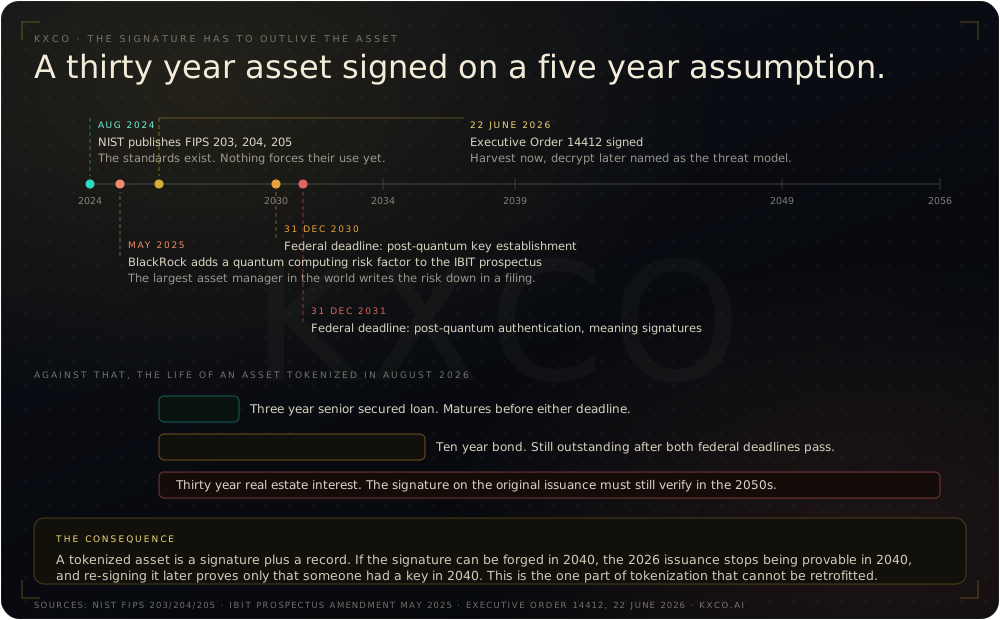
The consequence is specific rather than atmospheric. If a signature produced in 2026 can be forged in 2040, then in 2040 the 2026 issuance stops being provable. And the obvious fix does not work: re-signing the old record with a new algorithm in 2040 proves only that somebody held a key in 2040. It says nothing about 2026. Cryptographic verification has a start date and lives forward from it, which is why back-signing an archive is not an upgrade path, it is a false statement with a timestamp on it. Assets that outlive their cryptography do not get a second chance at being provable.
Why "we will migrate later" is a weaker plan here than elsewhere
For confidentiality, migration works reasonably well: rotate to post-quantum key establishment and future sessions are protected, with the residual exposure being data already captured. For authentication over long-lived records, migration does not work the same way, because the artefact you need to protect was already produced. A settlement record from 2026 has to remain verifiable in its original form. You can add a new signature alongside the old one, and you cannot make the old one stronger than it was on the day it was made.
That asymmetry is why the correct order is security first, then semantics, then product, and why a platform that adds post-quantum signing in year five has a five-year hole in its provenance that no amount of later diligence closes.
What KXCO actually runs
Armature L1 is a permissioned network with named validators running QBFT consensus, chain ID 1111111, with post-quantum signing designed in from genesis rather than added to an existing history. Every block on the current chain has been produced under that design, which is a claim about architecture and not about duration: the honest framing is that the chain has never had a classical baseline, not that it has decades of post-quantum history behind it.
Mechanically, ML-DSA-65 verification is performed off chain by the platform relay, which then anchors the verified result on chain through an ordinary registry contract. That is worth stating precisely because it is the sort of detail marketing tends to round off: the verification is real and the anchoring is real, and the arrangement is a relay plus a Solidity contract rather than a native cryptographic precompile in the client.
Update, 6 October 2026: ML-DSA-87, the category 5 parameter set CNSA 2.0 specifies, is now verified in consensus on KXCO's chain alongside ML-DSA-65, from block 4,951,111, per chain.kxco.ai.
The primitives are published, not asserted
The part that can be checked without talking to KXCO is the cryptography itself. The library family is published on npm under open licences, and it carries evidence rather than adjectives.
| Package | Version | What it does |
|---|---|---|
| kxco-pq | 1.2.4 | Umbrella package re-exporting the ecosystem, for when you want one dependency rather than eight. |
| kxco-post-quantum | 1.4.0 | Primitives: ML-DSA-65 and ML-DSA-87, ML-KEM-768, SLH-DSA, envelope signing, key identifiers. Ships with a build provenance attestation. |
| kxco-pq-sdk | 1.1.4 | Hierarchical institution identity: issue, revoke, attest, verify a credential chain offline. |
| kxco-verify | 1.2.0 | Browser-safe verifier that keeps historical records verifiable across key rotation. |
| kxco-pq-attest | 1.1.4 | Standalone attestation envelopes any counterparty can verify, in Node and in edge runtimes. |
| kxco-pq-audit | 1.2.0 | Hash-chained, signed audit log whose verify replays every signature and every previous-hash link. |
| kxco-pq-hsm | 1.1.0 | Key custody behind a hardware boundary. |
| kxco-pq-tls | 1.1.0 | Hybrid post-quantum channels: ML-KEM-768 with X25519, AES-256-GCM, optional mutual authentication. |
The conformance position, which is the part worth auditing rather than reading: the primitives pass NIST algorithm validation testing and cross-implementation interoperability checks against independent implementations, and the evidence is published so the results can be rerun rather than accepted.
11The agent as an approved party
The last piece is the one the market has barely begun, and it arrives sooner than the 2030 deadlines.
The IMF's 2026 note on agentic AI in payments makes the structural point cleanly: existing fraud and compliance frameworks were built to verify customers, not agents, and systems capable of executing payments expose gaps in KYC and multifactor authentication that assume an explicit human action at the moment of authorisation. It also flags a systemic dimension that is easy to miss, which is that agents at different institutions running similar models and reacting to the same signals raise the probability of correlated behaviour. The emerging industry vocabulary is "know your agent", along with continuous identity verification rather than a single check at onboarding.
For a closed environment this is not a new class of problem. It is the existing problem with a new kind of party, and the machinery already exists.
The agent holds its own credential
An agent operating inside the environment is credentialed like any other party. Its credential chains to a holder rather than directly to the institution, it names the human authority it acts under, and it carries an explicit scope.
Three properties of that arrangement are doing the work. The agent's authority is a strict subset of a human's and does not contain an approval capability, so an agent cannot approve its own proposal no matter what it decides. The agent's credential is short-lived, which converts a stolen agent key from a permanent compromise into a bounded one. And the chain is walkable offline, so a counterparty receiving an agent-signed envelope can establish, with no network call, that this agent was authorised by this holder who was admitted by this institution on this verification.
Propose, never approve
The behavioural rule is that an agent may read the ontology and propose an action, and may not resolve the check on that action. It is the same rule the platform already applies to a fund administrator, which is not a coincidence: both are parties who prepare work for an accountable party to approve, and it turns out that a governance pattern designed for a human role transfers to a machine role without modification. That is a good sign about the pattern.
The resulting state change is signed and anchored identically to a human's. There is no separate, quieter path for machine-originated actions, which matters because a separate path is exactly where attribution goes to die.
What the alternative looks like
The prevailing arrangement, which is where most of the market currently sits, is that an agent transacts as its principal using the principal's credentials. Everything it does is indistinguishable from something the human did. When it goes wrong, and at sufficient volume something always does, there is no way to establish afterwards whether a person or a model made a given decision, under what instruction, or within what limits. The institution cannot answer the question, so neither can its supervisor.
That is a supervision problem well before it is a technology problem, and it is not solved by better model evaluation. It is solved by the agent having its own identity, its own scope and its own signature.
Reading, and the discipline it requires
There is a second reason the ontology matters specifically for agents rather than generally. An agent cannot ask what a field means. It has no colleague to phone when two systems disagree about whether something has settled, and no instinct that tells it three spellings of a counterparty name refer to one entity. A human supplies that missing meaning thousands of times a day without noticing, and that improvisation is the substrate the existing financial plumbing quietly runs on. Remove the human and the substrate is gone. What is left has to be self-describing, or the agent makes a confident decision on a misunderstanding.
This is why typed claims and first-class opacity states are not academic. An agent that can tell the difference between a value of zero and a value nobody established will decline to act on the second. An agent reading nulls will treat them as zero, and the failure will be silent, fast and repeated.
12Quantum and AI, one requirement
It is tempting to treat post-quantum cryptography and AI agents as two unrelated items competing for the same roadmap. They are the same requirement approached from opposite ends, and the requirement is provable attribution.
Take the agent side first. An agent acting on an institution's behalf is only safe if every action it takes is attributable to a specific credential, a specific delegated authority and a specific moment, and if that attribution can be checked later by somebody who was not present. Attribution that can be checked by an outsider is a signature. So the value of an agent's entire audit trail is bounded by the useful life of the signature scheme underneath it. Deploy autonomous agents into a settlement environment on cryptography with a stated end date, and the evidence they generate inherits that end date.
Now run it the other way. Post-quantum signatures without a shared model of meaning give you unforgeable records of statements that different parties interpret differently, which is a durable record of an ambiguity. Excellent cryptography, no agreement. And a shared model without post-quantum signatures gives you a system in which everybody agrees what happened and nobody can prove it in twenty years.
The ontology supplies meaning. The credential supplies authority. The post-quantum signature supplies durability. Remove any one and the other two stop being worth much.
Which is why these are not three features that happen to ship together. They are three necessary conditions on one property, and the property is that a claim about ownership can be understood, attributed and proved by an arbitrary third party at an arbitrary later date. Every component in this piece exists to serve that sentence.
There is a practical corollary for anyone sequencing work. The cryptography has to be first, because it is the only one of the three that cannot be applied retrospectively to records already made. Meaning can be enriched later, badly and expensively, but it can be. Authority can be tightened later. A 2026 signature cannot be improved in 2040.
13Three models, eight questions
The three prevailing approaches to tokenizing real world assets are not competing for the same job, and comparing them on throughput or fees obscures that. The useful comparison is to ask each of them the same eight questions and read the answers side by side.
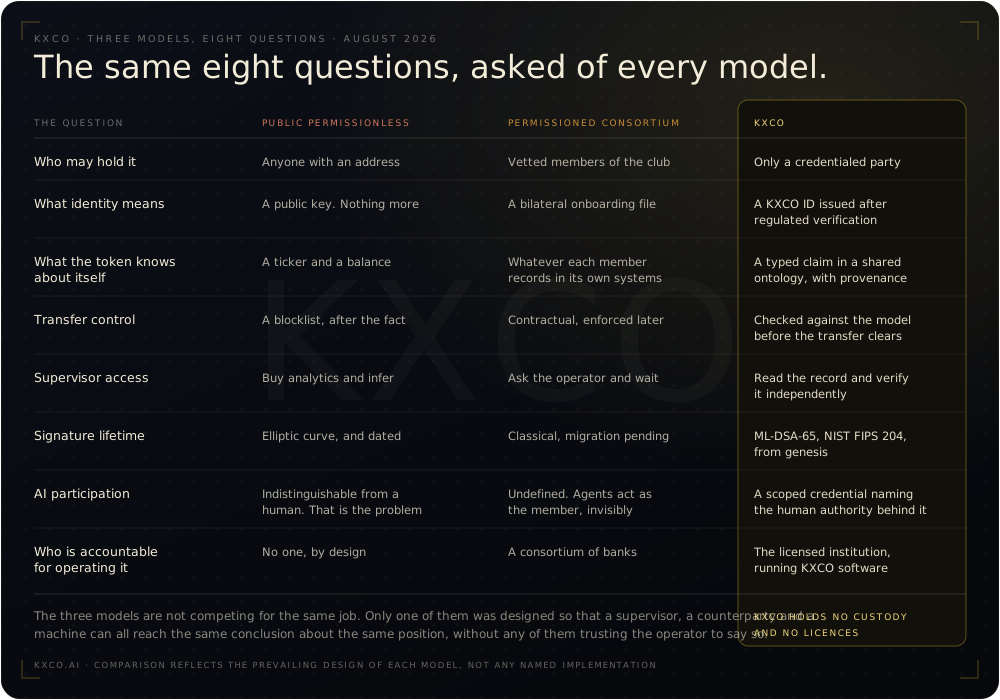
A permissionless public chain is an outstanding settlement venue for bearer assets and a poor one for registered instruments, and this is not a criticism of the design, it is the design. Nobody is accountable for operating it, which is the property that makes it censorship resistant and the same property that makes it unable to answer a supervisor. Identity is a public key. Transfer restriction is a blocklist applied after the fact. An AI agent is indistinguishable from a human, which in this context is not a philosophical observation but a compliance gap.
A permissioned institutional consortium fixes admission and leaves meaning unfixed. Members are vetted, so the who question has an answer. But meaning still lives in each member's own systems, which means the same instrument can be understood differently at two ends of the same trade, and reconciliation continues to be a business function. Transfer control remains contractual. A supervisor asks the operator and waits. And in the versions running today, the signatures are still classical, with migration listed as future work.
The closed environment described here is not a claim to be better on every axis. It is a claim to be the configuration in which a supervisor, a counterparty and a machine can all reach the same conclusion about the same position, at the same time, without any of them having to trust the operator to tell them. That is a narrower claim than "the best chain" and a more useful one.
14What we claim, and what we don't
Precision matters more than enthusiasm, and a piece this long earns the right to be read only if it is honest about its own boundaries. Here is the line, as at August 2026.
What is running
- Armature L1 runs as a permissioned QBFT network with named validators, chain ID 1111111, post-quantum signing designed in from genesis. ML-DSA-65 and ML-DSA-87 signatures are checked by the platform relay and verified in consensus on chain by the registry's verifying contract.
- Credential issuance is live, with hierarchical ML-DSA (FIPS 204) credentials issued under a dedicated institution key held on the operating host, an approval queue for holder-submitted profile changes, and a public identity page per holder.
- NDA-gated data rooms with double opt-in email verification are in production, with rooms as first-class objects carrying their own owner and named co-administrators.
- The register and capital machinery is in production: effective-dated capital tables, allocations that reconcile exactly or refuse, capital calls split as at the call date, value-dated payments, waterfall distributions, preferred return accruing on outstanding rather than contributed capital, and bank reconciliation requiring positive payer identification.
- Selective on-chain attestation is live, opt-in per organisation and per event type over a fixed enumerated event list, with a public unauthenticated verification endpoint that returns hashes and metadata and never content.
- The post-quantum library family is published on npm with an open licence, a build provenance attestation on the primitives package, and conformance and interoperability evidence anyone can rerun.
What is architecture rather than shipped
- KYC-gated issuance through a regulated provider is the designed admission path and the SDK carries the verification reference through the credential. On the live identity product, issuance today is attested by an administrator, and provider-gated automatic issuance is the next phase rather than a current capability. Where this piece describes the door, it describes the design; the human-attested version is what is running.
- Ledger-level transfer restriction is the right end state for a transferable instrument. Enforcement today lives in the platform's permission model over its own state transitions, which is a strong control, and ledger-level enforcement of the same checks is the next phase.
- A CPMI-IOSCO self-disclosure and a full ISO 20022 mapping are identified as load-bearing procurement artefacts, and naming them as necessary is not the same as having published them.
- The native cryptographic precompile is not the mechanism in use. Verification is off chain in the relay with on-chain anchoring, and that is the accurate description.
What KXCO is not
KXCO is a software company. It does not custody assets, does not hold client money, does not operate an exchange or a marketplace, and holds no financial licences in any jurisdiction. It builds the platform that licensed institutions operate, and the institution carries the regulatory obligations. This is why verification is delegated to a regulated provider rather than performed in-house, why custody is the customer's choice of provider or its own arrangement, and why nothing in this piece should be read as KXCO offering a regulated service.
One further honesty note, on the ontology. It does not discover anything. It is an instrument, not an oracle. Where a finding appears, a person recognised it because the structure had been rendered legibly enough to be recognisable. Claiming otherwise would be a better story and a worse description.
15How to build against it
The parts of this that are open can be exercised today, without an account and without talking to anyone. That is deliberate: a trust claim that requires a sales conversation to inspect is not a trust claim.
Install and verify a credential chain
The identity layer is the natural starting point, because it is the piece that makes everything else attributable.
npm install kxco-pq-sdkimport { KxcoIdentity } from 'kxco-pq-sdk'
// Any third party checks a whole credential chain with no network call.
const result = KxcoIdentity.verifyChain({ envelope, credential, institutionPublicKey })
// result.valid, result.role, result.authority, result.issuedByThe property to notice is that verifyChain is offline. A counterparty, an auditor or a supervisor needs the envelope, the credential and the institution's public key, and nothing else. No endpoint to call, no availability dependency, no permission from the institution whose credential is being checked. That is what makes the closed environment inspectable from outside it.
Handle rotation properly
Design for rotation from the first record. A verifier that reports a rotated key as invalid will fail every historical record the day a key changes, and the failure will look like data corruption rather than what it is. The published verifier keeps historical records valid across rotation, and rotation itself is verifiable.
npm install kxco-verify kxco-pq-auditPair verification with the hash-chained audit log if you are recording anything a supervisor might later ask about. Its verify() replays every signature and every previous-hash link rather than checking the head entry, which is the difference between an append-only log and a tamper-evident one.
Put keys behind a boundary before production
The HSM package keeps signing keys behind a hardware boundary. What is not acceptable is a long-lived institution signing key sitting in an environment variable, because the institution key is the root of trust for every credential beneath it.
Check the claims before you believe them
Three things in this piece are independently checkable and should be checked rather than accepted:
- The primitives. Install
kxco-post-quantumand run the conformance harness against the NIST validation vectors yourself. - The interoperability. Run the cross-implementation checks against an independent implementation and confirm they hold.
- The record. Take an attestation from the public verification endpoint on Meridian and check its signature and its anchor yourself. It returns hashes and metadata rather than content, which is the point: you can confirm a fact was recorded at a time without being shown the underlying document.
If any of those three do not hold, the rest of this piece does not matter, which is the correct order in which to evaluate it.
16Frequently asked questions
What is real world asset tokenization?
Recording ownership of an off-chain asset, such as a bond, a fund interest, a loan participation or a property interest, as a transferable unit on a shared ledger, so that issuance, transfer and settlement can be automated. The token is a representation of a claim. It is only as useful as the environment's ability to say who holds it, whether they are permitted to, and what the claim means.
Why is digital identity the bottleneck in tokenization rather than the token itself?
Because minting and settling a token is now routine engineering, while establishing who the holder is in law is not. A public blockchain address carries no jurisdiction, no eligibility, no accreditation and no sanctions status, and gives no indication of who controls the key. Larry Fink put it directly in BlackRock's 2025 chairman's letter: championing tokenization alone will not suffice, digital verification has to be solved too.
What does a closed environment of known and approved parties mean?
It means there is exactly one path to holding a position, and it runs through verification. A person is verified by KYC and an entity by KYB, both performed by a regulated provider, screened for sanctions and politically exposed status, after which the operating institution issues a signed credential. Anonymous addresses, unverified wallets and unattributed AI agents are never admitted, so they cannot hold a position at all rather than being blocked after the fact.
Does a closed environment mean nobody outside can check anything?
No, and this is the distinction that matters. Admission is closed and verification is open. Any counterparty, auditor or supervisor can verify a proof using a published public key and the record, with no account and no permission, and without trusting KXCO's word for it. A closed environment is not an opaque one.
What does the ontology add that a database schema does not?
A schema says how a value is stored. The ontology says what it means, and every value is a typed claim carrying its source, the date on which it was true, a confidence and the basis of the claim. Applied to a tokenized instrument, that means the token knows what kind of instrument it is, which classes of holder may hold it, in which jurisdictions and under what restriction periods, so every participant resolves the same meaning instead of each keeping a private interpretation.
How are transfer restrictions enforced?
As a condition evaluated before a transfer clears, not as a contractual term investigated afterwards. A proposed transfer is evaluated against the instrument's own terms and the parties' standing before anything clears, and a refusal states its reason and is recorded. A control that leaves no trace when it fires is not evidence of a control, so refusals are on the record alongside approvals.
Why does post-quantum cryptography matter for tokenized assets specifically?
Because a tokenized asset reduces to a signature plus a record, and long dated assets outlive cryptographic assumptions. NIST published FIPS 203, 204 and 205 in August 2024, and Executive Order 14412 of 22 June 2026 sets federal deadlines of 31 December 2030 for post-quantum key establishment and 31 December 2031 for post-quantum authentication. A thirty year interest tokenized today needs its original issuance signature to verify in the 2050s, and re-signing it later proves only that somebody held a key later.
How do AI agents participate without breaking the compliance model?
An agent is a credentialed party like any other. Its credential is scoped and names the human authority it acts under. It may read the ontology and propose an action, and it cannot approve one. The same permission check that gates a human's transfer gates the agent's, and the resulting state change is signed and anchored identically. The IMF has warned that existing KYC and multifactor frameworks verify customers rather than agents, which is why attribution has to be built in rather than inferred.
Does KXCO hold client assets or operate the tokenization platform?
No. KXCO is a software company with no custody, no client assets and no financial licences. The licensed institution operates the environment and carries the regulatory obligations. KXCO supplies the software those obligations are enforced by, which is why verification is delegated to a regulated third party provider rather than performed by KXCO.
What is live today versus described as an architecture?
Armature L1 runs as a permissioned QBFT chain with named validators and post-quantum signing from genesis, with ML-DSA-65 and ML-DSA-87 checked by the platform relay and verified in consensus on chain by the registry's verifying contract. Credential issuance, NDA gated data rooms with verified email, effective dated capital tables, value dated capital calls, waterfall distributions, bank reconciliation requiring positive payer identification and opt-in on-chain attestation with a public verification endpoint are all in production. The post-quantum library family is published on npm with conformance evidence anyone can rerun.
17Sources
- Larry Fink, 2025 Annual Chairman's Letter to Investors, BlackRock. Source of the tokenization and digital verification passages.
- Larry Fink Annual Chairman's Letter, BlackRock, 2026. Digital wallet framing, the 1996 internet comparison, and the call for clear rules on investor protection and digital identity.
- Nina Bambysheva, Why Tokenization, Otherwise Known As Wall Street's Great Rewiring, Finally Looks Real, Forbes, 10 August 2026. Asset class breakdown and the Citi projection.
- Chairman Paul S. Atkins, Keynote Remarks at The Economic Club of Washington, U.S. Securities and Exchange Commission. The innovation exemption for tokenized securities.
- The path to the next-generation monetary and financial system lies in safeguarding trust in money, Bank for International Settlements, 23 June 2026. Unified ledger, Project Agorá, and the quotation from Pablo Hernández de Cos.
- Securing the Nation Against Advanced Cryptographic Attacks, Executive Order 14412, 22 June 2026. Federal post-quantum deadlines and the harvest now, decrypt later threat model.
- How Agentic AI Will Reshape Payments, IMF Note 2026/004. KYC gaps for agents, know your agent, and correlated agent behaviour.
- BlackRock Updates Bitcoin ETF With Broadened Warning About Quantum Computing, The Quantum Insider, 13 May 2025. The IBIT prospectus quantum risk factor.
- Kinexys by J.P. Morgan. Permissioned institutional network, vetted counterparties, and the deposit token's eligibility model.
- FIPS 204, Module-Lattice-Based Digital Signature Standard, NIST, August 2024. The ML-DSA specification.
- KXCO, the live market ontology, the post-quantum package family on npm, Armature L1 post-quantum design and validator set.
- Shayne Heffernan, Real World Asset Tokenization: The Missing Half, and Why KXCO Built It First, Live Trading News, 19 August 2026. The shorter market-facing version of this argument.
Nothing is issued before somebody is known.
See the closed environment applied to private capital, or talk to us about your instrument.